The Tuesday Bride: Why three salons came up on Google and only one got the booking
A bridesmaid needs wedding hair in four days. Three local salons show up. Why two of them never get a tap, and how the third locks in $1,200 of revenue in two minutes.

Tuesday, 8:47am. Lily is sitting at her kitchen table in Mt Eden, holding a cup of tea that's gone half-cold while she scrolls. Her sister is getting married Saturday. The hair appointment that was booked three weeks ago has just been cancelled by text, the stylist is sick. Lily has four days.
She does what most people do when they need something local and they need it now. She picks up her phone and types "wedding hair near me Ponsonby" into Google.
Three local salons come up on the map. The decision about which one she calls is mostly made before she taps anything.
What the customer actually sees in the first four seconds
Before Lily clicks into any salon's website, her eye runs over the Google Business Profile snapshot: the photo grid, review count, the "open now" badge, the response-time line, the date of the last photo upload, the list of services. That snapshot is the entire pitch.
For a wedding hair search, photos do most of the talking. Lily is not reading words yet. She is scanning images, looking for proof that this salon has done bridal hair before, on real people, on hair like hers.
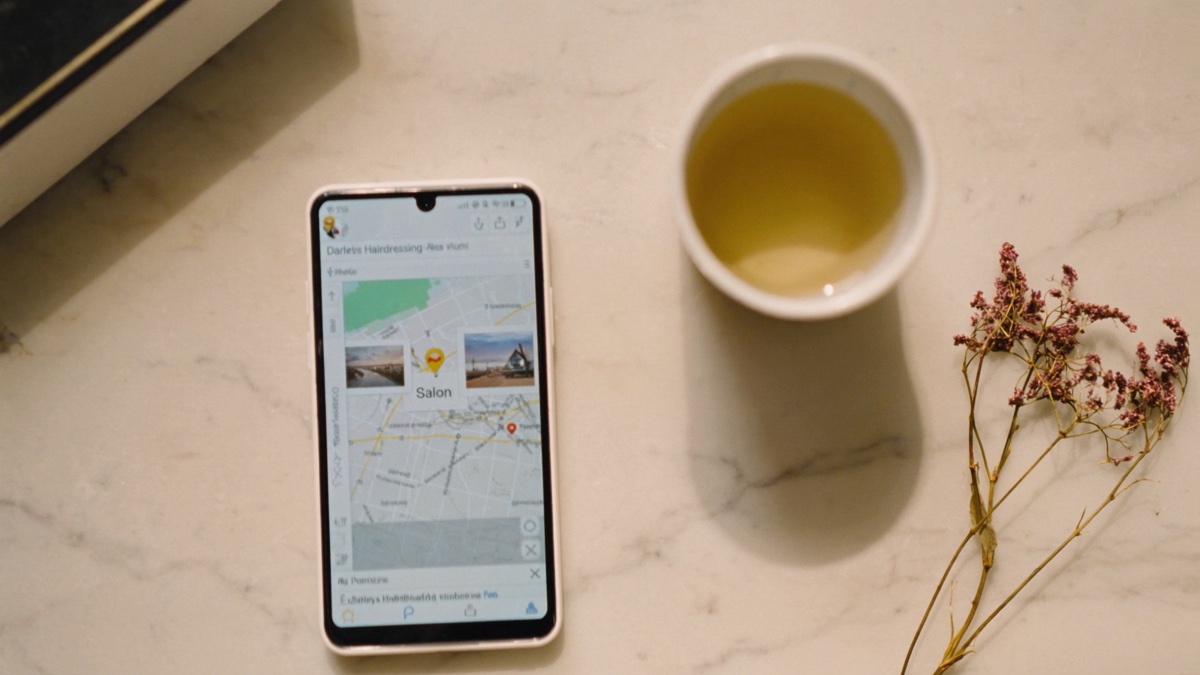
Salon One: invisible
The first listing is local. Five years in business. Eighteen reviews at 4.6 stars. But the GBP photo grid is six stock images of generic salons, the kind that come bundled with the website template. The service categories list "Hair salon" and that is it. No mention of bridal styling, no mention of trial appointments, no mention of weddings at all.
Lily scrolls past in 1.2 seconds. She does not consciously decide. Her thumb moves before her brain finishes registering it. The salon may well be brilliant at wedding hair, but the profile gives Lily no reason to find out.
Salon Two: visible, but mute
The second listing is strong. 142 reviews at 4.8. Photos uploaded last week, real client work, three of them tagged as "wedding day". Service list includes cut, colour, men's, bridal, balayage. The "open now until 6pm" badge is on. Lily taps. The phone rings.
The salon owner is mid-foils with a regular and the assistant is washing a colour out at the basin. Nobody picks up. After eight rings, voicemail kicks in: a generic message asking the caller to leave their name. Lily lets it ring out, hangs up before the beep, and taps the back arrow.
She is not going to leave a vague voicemail about her sister's wedding hair. She is going to try the next salon.
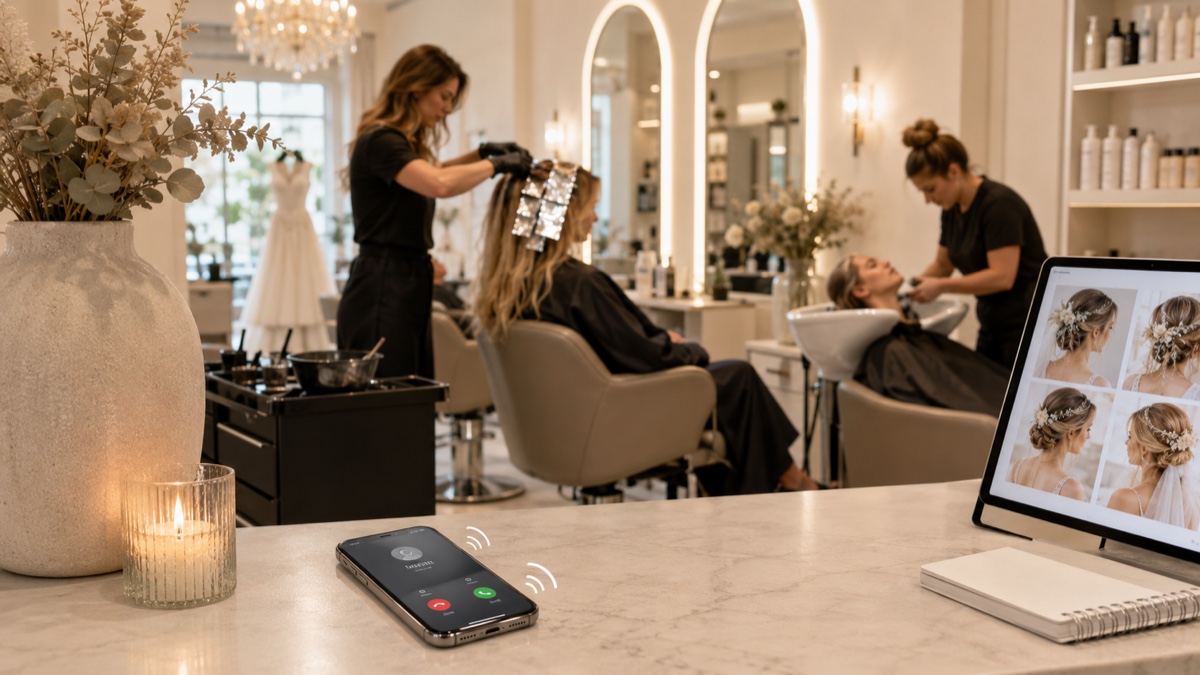
Salon Three: visible, and listening
The third salon has the same Google Business Profile signal-strength as Salon Two. Photo grid recently refreshed, every wedding job photographed properly, services itemised clearly. But this time, when the call rings out at the salon, an AI Concierge picks up on ring three.
It does not pretend to be human. It just gets to work.
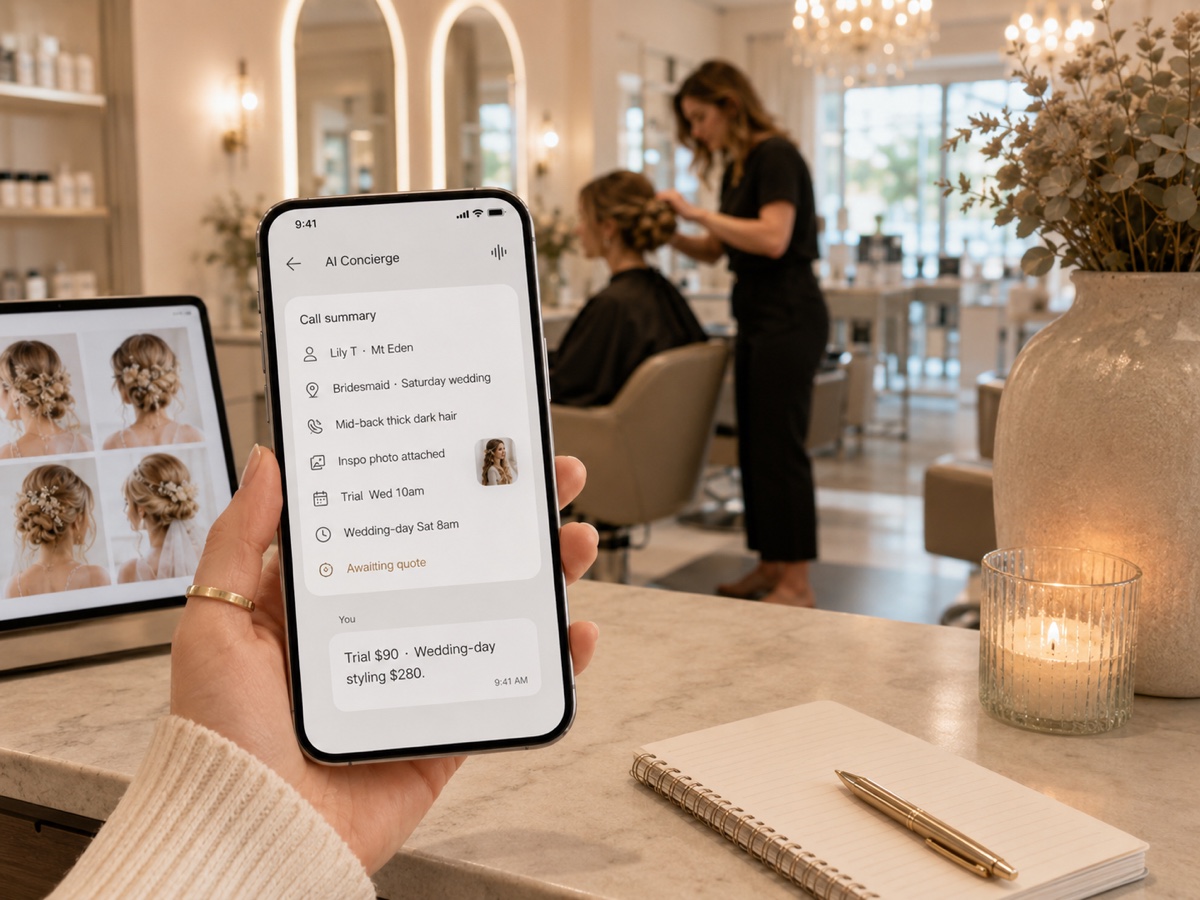
Two minutes. By 9:15am, a clean job summary lands in the salon owner's phone: Lily T, Mt Eden, mid-back thick dark hair, bridesmaid for Saturday wedding, inspo photo attached, trial booked Wed 10am, wedding-day booked Sat 8am, awaiting quote.
The owner sees it between clients. She replies with a one-line quote: trial $90, wedding-day styling $280. Lily confirms. The booking is locked.
The math, plainly
Wedding hair in Auckland sits in the $250-$600 range per stylist per appointment, with most weddings booking the bride plus three to five attendants. A single wedding job is rarely under $1,200 in salon revenue.
Most salons book between two and four wedding clients a month from local search alone, and lose at least one a week to phones rung out. Annualise it. The number is bigger than people want to admit.
The same dynamic is true in every service business. The single biggest reason a salon, a clinic, or a tradie stays small is not lack of demand. It is the gap between demand arriving and demand getting captured.
Two pieces, working together
Google Business Profile gets you found by ready-to-book customers. AI Concierge keeps you in the conversation when the chair is full, the assistant is in the basin, and the phone is across the room.
Each piece alone is half the story. A great GBP that rings out to voicemail still loses the call. An AI intake hooked to a phone number nobody can find on Google never rings at all.
The salons that win the Tuesday-morning bookings have both pieces dialled in.
What "good" actually looks like for a salon
None of this is rocket science. It just needs to be set up properly once, and then it earns money in the background while you're mid-foils.
Want to know which piece is costing your business the most right now? Send me the problem — a one-line note about what feels broken, with a URL if you have one. A specific, written reply lands within 24-48 hours. No call, no sales sequence.